
Research

Overview
About wells on your property:
Our interactive dashboard provides enough information for you to conduct your own research into wells relevant to you. The state regulator (Railroad Commission, RRC) offers this guide about how to research wells that may be on your property, and their map-based well viewer contains a good deal of information. (It should be noted that the map does not include hundreds of thousands of wells lacking latitude-longitude coordinates.) This page allows the public to search its records for various kinds of data submitted on these forms. Separately, this map created by the Groundwater Protection Council also links to relevant information about individual wells in Texas.
Problem of orphaned wells:
For you to conduct your own research into the consequences and solutions of idle and orphaned wells, we can recommend these general resources:
The federal Government Accountability Office has published reports in 2011, 2019, 2024, and again in 2024 about the systematic risk to taxpayers of the lack of funding for decommissioning of wells and infrastructure within federal jurisdiction.
The National Academies of Science recently published a consensus study addressing many topics related to orphaned wells, including background about the issues they present. This recent “Technical Explainer” by think tank RMI also describes some of the issues of unplugged wells. And this peer-reviewed research article summarizes key points.
The U.S. Department of the Interior has been studying and trying to address the problem of orphaned wells for several years, and they have published some excellent studies.
The U.S. Geological Survey has conducted many studies, including one on the risks to groundwater shown also on this interactive map.
The most comprehensive treatment of the range of policy solutions can be found in Part 2 of this report by the Ohio River Valley Institute.
The text below synthesizes and cites additional material about specific issues and solutions.
Consequences
-
Buyers of land in Texas rarely receive the financial benefit of on-going production on the land. Instead, they are burdened with the loss of function and beauty of the property and concerns about air pollution and water pollution. They also face the risk of the failure of plugged wells without any company available to take responsibility.
The effects of old plugged and unplugged wells on property value and surface development seems obvious, but it remains mostly anecdotal except for one important study from Pennsylvania established a marked loss of development.
-
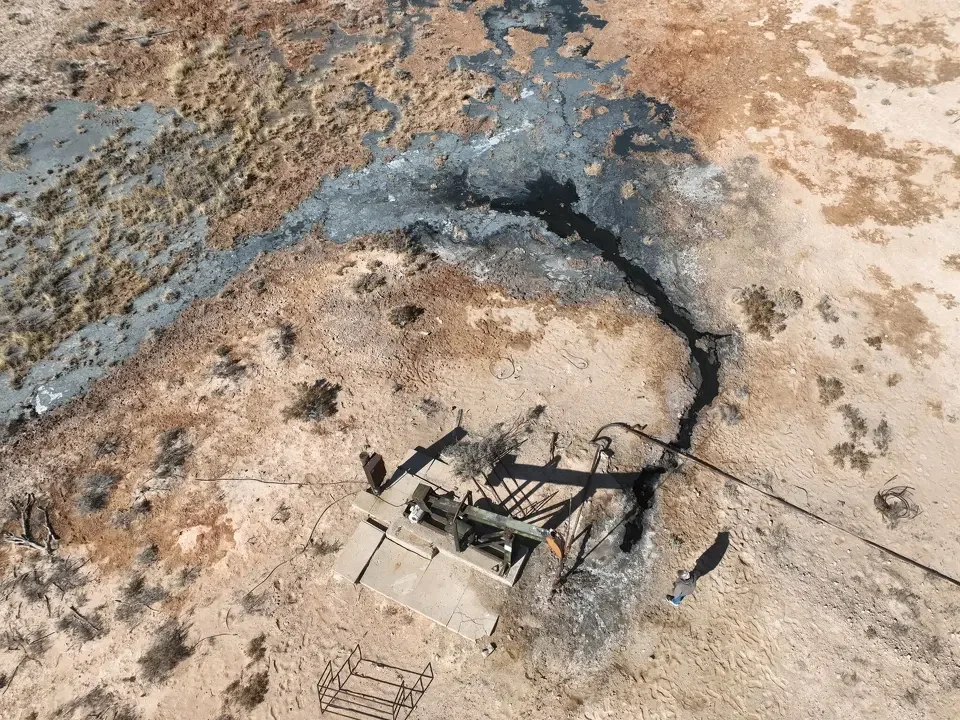
Oil and salt water spills on the soil harm its ability to grow plants, accommodate wildlife, and host development. While oil eventually biodegrades, salt water permanently changes the composition and nature of the soil. When not cleaned up, the pollution can leach deep into the soil and contaminate the shallowest groundwater.
Most releases happen during production and injection operations. The RRC regulates most releases, though the Texas Commission on Environmental Quality (TCEQ) and General Land Office (GLO) can be involved. As described on page In the News, subsurface fluids can occasionally break out of idle and even plugged wells to create a lake, stream, or geyser of hypersaline fluids.
The RRC requires that operators self-report spills of more than 5 barrels (210 gals) of liquid hydrocarbons on land, and a database of historical spills can be found at this link. When in doubt, the RRC offers this ”field guide” to assessment and clean-up of condensate spills and this ”field guide” to reporting and clean-up of crude oil spills in non-sensitive area.
Rules and records related to releases of produced water are not as consistently stated or recorded.
-
Leaching of surface spills down through the soil is the most common mechanism for oil and gas operations to pollute groundwater, so most jurisdictions have disallowed storage of produced oil and water in unlined earthen pits for decades. However, reservoir fluids can also pass directly into groundwater reservoirs without first coming to the surface.
When fluids break out through the soil or flow up outside of the wellbore’s casing (see In the News), then the salt water has come in direct, pressurized contact with subsoil and likely freshwater formations on its way to the surface.
When a sinkhole opens up, it is direct evidence that enough water has been moved into a new formation to dissolve a subsurface cavern. (The collapse of the dissolution cavern creates the sinkhole.)
Most worrisome, pressurized fluids can move from deep formations into groundwater formation without any evidence at the surface. Regulations require a cement plug at the surface, and cement around the casing at the surface. It is possible for deeper barriers to fail while the surface barriers hold, allowing fluid to cross-flow invisibly from one subsurface formation into another. Pressurized oil and gas zones could lift water up and into shallower groundwater zones with no evidence at the surface.
-
The nature of the risk and the significance of possible consequences are widely understood, and the need for prevention is widely accepted. At the same time, proving the cause of groundwater contamination is a difficult problem of geochemistry and physical dynamics, and the causes of many episodes of groundwater pollution remain unknown.
The contaminants in the polluted water may not be the same as those in the root cause of the pollution. Injection puts the waste water in the area immediately around the injection well, but it creates higher pressure over a much wider area. It is the natural water previously present throughout the pressurized area–not the newly injected water–that is most likely to be moved to the surface or groundwater.
In addition, the subsurface water or natural gas can react chemically with the fluids, minerals, and even the microbes present in fresh water aquifers. So, the resulting pollution can be chemically different from the fluids which moved into the zone originally.
A few cases of contamination by cross-flow have been proven, and others have been alleged. But many more cases of groundwater pollution remain unresolved. Because of the potential scale of the problem and the critical value of groundwater, policy has for decades prescribed prevention and protection by plugging.
-
Natural gas is a blend of molecules. Methane is almost always the largest constituent, and the concentration of each heavier hydrocarbon molecule declines significantly.
Though not visible and often odorless, natural gas creates air pollution three ways.
Some minor constituents of natural gas are themselves dangerous, notably benzene , other volatile organic compounds, and sometimes hydrogen sulfide. Not all natural gases contain these molecules, but they are potent in low or very low concentrations. They are more likely to be present when crude oil is produced than when production is mainly gas. In addition, volatile organic compounds are more likely to be present when the smell of crude oil is present.
Secondly, hydrocarbon gases create ground-level ozone as they react in the atmosphere, creating the common type of air pollution. Also called smog, it is among the major types of pollution tracked by the American Lung Association.
Before it decomposes , methane is a super powerful greenhouse gas. In aggregate methane is responsible for about one-third of all global warming to date.
In addition, when methane is released below the surface instead of directly into the are, it can pollute groundwater and soil.
-
Because it is buoyant, lighter and less viscous, natural gas travels upward through wellbores much more easily than water or oil. Even when depleted, oil and gas reservoirs commonly contain hundreds of psi (pounds per square inch) of pressure in the gas phase, more than enough to lift it all the way to the surface when not completely obstructed by barriers and/or liquids.
Most leaks occur through the wellhead or surface equipment, but natural gas can also breach the casing downhole and migrate upward on the outside of the casing and other equipment. It can pass through or adjacent to groundwater formations, and it can seep up through the soil.
Leaks of gas into a fresh water aquifer can result in methane gas entering the water supply, but in other cases microbes consume the natural gas and drive other chemical reactions. Pollution of groundwater by natural gas sometimes comes in the form of other chemical contaminants.
-
Many research projects have tested the possible effects of oil and gas operations, and several meta-analyses have examined the patterns of health consequences to people living, working, or going to school near oil and gas facilities. A blue-ribbon panel of experts in California produced this 500-page synthesis in 2024.
This 2026 study by the oil and gas regulator of Colorado reviewed research focused in that state.
Independent scientific research institute PSE Healthy Energy has made a number of studies, including this peer-reviewed study in 2025.
This 9th edition of a literature review by Physicians for Social Responsibility looks specifically at outcomes near hydraulic fracturing sites.
-
The third mechanism of harm is global warming. Methane, which usually constitutes the large majority of natural gas, is also a powerful greenhouse gas responsible for about 30% of all global warming. The excess release of methane by people over and above natural sources has been targeted by policymakers and advocates as the fastest, easiest and cheapest way to slow the warming.
For its part of methane pollution, the oil and gas industry has also broadly accepted and endorsed the need to reduce emissions, though overall performance in Texas remains far above targets.
-
Research consistently shows that most methane emissions come from low-producing wells and that low-producing wells are much more likely to release some or all of the produced gas.
For example, Williams et al 2025 found that production well sites are responsible for 68% of total upstream and midstream emissions and 44% comes from low-producing well sites alone. They also found that facilities with comparatively lower individual emission rates — nearly all sites studied — collectively account for roughly 70% of total measured methane emissions. It must be noted, though, that the patterns of emission do vary between producing areas and jurisdictions.
This study shows that the largest source of methane pollution in Texas is the continuous, intentional release of low-producing wells.
-
In aggregate, idle wells emit much less methane on average than producing wells. On the other hand, Texas includes more than 100,000 officially inactive wells and hundreds of thousands of low-producing wells that are commonly shut-in for months at a time.
Most wells emit little or no gas, but some wells emit higher volumes. The proportion of wells that leak and the rates at which they leak vary significantly among wells and regions. For example, one Texas specific study reflects this variability, surveying 37 shut-in and other non-producing wells in the Permian Basin and finding methane emissions rates ranging from below detection to a rate equal to 1,156 kilograms per year. (Townsend-Small & Hoschouer 2021).
The longer wells stand idle, the more likely they will develop significant leaks.
-
Generally, proper plugging to modern standards is believed to mitigate leaks of gas as well as oil and water. However, little research has been done to understand the frequency, causes or effects of failures in plugged wells. Because the top of the well is usually below the surface, leaks can go undetected.
The potential for leaks applies nationwide to nearly 2 million wells known to have been plugged and up to another 1.8 million were left behind before modern plugging standards. (Purvis 2026) Plus, the risk of breaching a plugged well increases when there is injection in the vicinity.
In some cases, plugged wells have been found to leak natural gas, though at rates much lower than unplugged wells. In the Antina Ranch in west Texas, for example, nearly all of the plugged wells were found to be leaking gas.
In Texas as well as other states, water has broken through plugged or other legacy wells and flowed to the surface or into the ground near the surface. The Middle Pecos Water district has documented numerous flowing wells which threaten groundwater. Water recently broke through an old well in a church parking lot in Grandfalls, Texas. Sinkholes have formed by the flow of subsurface water both in west Texas and in East Texas. Most dramatically, sudden and complete failures have on a few occasions created tall geysers of highly saline water.
-
At initial completion, wells should not allow any kind of leak at the surface or below, but as a well ages, the risks increase. Metal corrodes above ground and below. Cement can crack and separate from the casing. Unfortunately, there is not a way to predict when or how a well will fail.
We do know that initial quality of construction is a primary variable; the wells drilled and constructed by some companies are more prone to failures than other wells in the same areas. After construction, risk factors include the age of the well, the types of fluids historically produced, the presence of pressure in the equipment, humidity of the surface, chemistry of the soil and groundwater, and the proximity to low-level seismicity.
The more stressors placed on a well and the longer it stands idle,the more likely it is to develop leaks.

Solutions
-
The primary benefit is, of course, saving the public from living with the consequences of unplugged wells and from the of cost paying for the clean-up which is the responsibility of the company. Those are obvious, widespread, and actionable reasons. Surveys show very high levels of support for policy solutions, and a number of jurisdictions are trying to make changes.
However, the debate on how and how much often turns to discussion of secondary, unintended consequences in the short term.
A failure to act compounds the problem and increases the future pain. Already the issue has accumulated to the point that all solutions are painful, none are easy. But the failure to act now will only allow more wells to end up in the hands of the public.
True that some companies already would not be able to comply with increased accountability, but a company which cannot pay for some or all of its clean-up responsibility now will very likely not be able to pay for it in the future after production declines.
-
Industry often argues that changes to policy meant to reverse years of permissive oversight will damage the industry and thus energy security, local employment, and local tax revenue, especially among small companies.
The argument, however, overstates the significance of small companies and low-producing wells. Plus, it does not consider how the problem will get worse without a change in policy.
Despite the large number of small companies, they in aggregate own and operate only a small portion of wells. What is more, theory and the history in Texas show that the most productive wells in the portfolios of small companies will continue to produce.
More importantly, the large majority of unplugged wells contribute very little to production or economic activity. Nationally 1.9 million remain unplugged today. (Purvis 2026) About half of those are inactive or do not contribute directly to production or economic activity. Among active wells, about 80% are considered “marginal” or “stripper” wells, and they contribute about 6% of national production. More to the point, many stripper wells produce less than 1 barrel equivalent per day.
The least productive 75% of unplugged wells (idle and < 1 bov/d) which are the primary target of reform contribute only 0.6% of national energy production. (Purvis 2026)
What is more, the liability and risk will continue to grow, so policy change is easier now than in the future.
-
The loss of economic activity from production is much less than the economic activity of remediating the history of development. Decommissioning is widely recognized as one of the best ways to create work and economic activity in communities impacted by declining production.
Despite increasing production in the state as a whole, employment in the oil industry of Texas has been cut deeply since 2015, and the losses are greatest in the areas with depleting, aging wells. In Texas, clean-up work could create 150,000 well-paying jobs. In Appalachia, it is estimated that a clean-up program could increase employment by 50% and (with appropriate funding) maintained steady employment for decades.
What is more, when Texas last increased its financial assurance requirements more than 20 years ago, the incidence of spills and environmental violation decreased in the years following.
-
Other states have tried in recent years to change policies to reduce the threat of orphaned wells–as has the federal lands, federal waters, and a couple of provinces in Canada–but none have yet been truly effective. Below are summaries and links about key the experience of other states:
Colorado: A law requiring additional financial assurance passed in early 2019 but was not fully designed and implemented until 2023. Problems with the design were identified early, and when fully implemented, the plan created no more financial protection than the state had previously. Meanwhile, approximately half of the wells in the state are not capable of funding their own decommissioning even if all future profits were dedicated to the task.
California: California has passed several measures. Allowing the regulator to require financial assurance up to $30 million on a company-by-company basis has created hundreds of millions of dollars of assurance against tens of billions of liability. And dramatic increases of idle well fees were required to accelerate the plugging of the large population of inactive wells (nearly 40% of all wells). The pace of plugging has increased significantly compared to previous pace, but the remaining liability is now a smaller portion of the value of the remaining production than it was before. The industry now faces a clean-up liability more than $18 billion greater than the funds available from operations in the state.
Federal lands: Studies by the federal Government Accountability Office found in 2010, 2011, 2018, 2019, and 2024 that financial assurance on federally-administered lands was inadequate. The Biden administration formed new rules to increase the financial assurance requirement by multiples. The policy would have increased the total assurance only marginally, but the Trump administration is in the process of reversing those rules before they could take effect.
Federal waters: In recent years, the federal government has increased its standards and financial assurance for oil and gas wells in federal waters, but the Trump administration also reversed those rules.
New Mexico: In June 2026, New Mexico passed a suit of new rules meant to protect against orphaning. Testimony about the possible effects are publicly available.
Utah: In June 2026, the state of Utah concluded several years of deliberations and passed new rules on financial assurance. Its effectiveness has not yet been tested, but much testimony was submitted about its potential effects.
Louisiana, Arkansas, and other jurisdictions have also created or are considering changes to their financial assurance and well plugging rules. Alberta was one of the first jurisdictions to begin increasing accountability, and it is currently considering a third round of tightening the rules.
-
The historical policies to prevent orphaned wells have demonstrably failed, and now the industry and public face a larger and more complex problem. Following are policies which have been deployed in the past or proposed for the future.
There is no single solution to address the wide range of situations in Texas, and there are no easy answers. The effective solutions for the public good will be the more painful ones for the oil industry.
To be clear, none of these policies change the requirement on oil and gas companies to decommission their wells and equipment. They only change the timing of funding that obligation. If companies cannot fund the obligation now, they are highly unlikely to be able to fund the obligation in the future after wells further deplete.
Financial assurance: This is the most traditional form of financial assurance. Companies are required to provide some form of financial assurance–such as performance bonds–to ensure the future ability to pay.
However, the policies have failed primarily because the amount of financial assurance is a small fraction of the actual liability (“blanket bonds”), because the value of the financial assurance did not increase as costs increased, and because the types of assurances allowed are often not reliable.
In Texas, companies can avoid providing any kind of financial guarantee, the guarantees are contracted only one year at a time (not permanently), and the value is never more than $250,000 even for companies with hundreds or thousands of wells.
Raising the required financial assurance by multiples would provide only a marginal change in the financial protection for the landowners and state.
Prompt plugging or additional guarantees: Historically in Texas, wells were required to be plugged or reactivated within 12 months of ending production, but the same policy in New Mexico led to a large number of nominally producing wells. Recent reforms in New Mexico now require single-well financial assurance on the lowest producing wells.
Full assurance at completion: The money for decommissioning is most readily available when the capital is spent for drilling, and the wells begin production. Full financial assurance could be required when wells are drilled.
Financial review, Full assurance at transfer: Texas makes no review of the financial ability of a new company that assumes responsibility for oil and gas wells in the state. Some states like Alaska and Michigan have long had procedures to review a transfer before it is approved, and recent reforms in New Mexico now also also for some review of the company and people wanting to take over operations of a well. (The review and permission pertain to the operations and financial responsibility for the wells, not to the ownership of the wells.) And Arkansa pioneered the requirement of full assurance at transfer.
California passed a law requiring full financial assurance at transfer, but financial assurance did not increase. The transfer of individual wells practically ceased, but the law was determined not to apply to changes of corporate control. Changes in corporate control do change the management team, corporate strategy, and financial strength of the company even if the name of the company does not change.
Idle well fees: Some jurisdictions have created annual fees on idle wells, and the revenues can be used to plug orphaned wells. However, the fees have mostly been set so low that they neither create significant funds nor increase plugging activity. In theory, the annual cost of the fee must exceed about 10% of the cost of plugging in order to change the capital spending decisions of companies, and the experience of California shows the lack of change until the costs became painfully high.
Plugging plans: Colorado and California now require that companies provide plans for how they will plug their wells or increase their financial assurance over a number of years. However, the years of discussion and compromise with industry in Colorado resulted in no more financial assurance than was previously held.
Predecessor liability: Some jurisdictions hold previous owners of wells responsible for decommissioning if the current own defaults on its obligations, such as Louisiana, federal lands, and sometimes in New Mexico. Such a policy keeps the financial burden on companies which did benefit financially from the wells. A residual liability can be created starting now and affecting future transfers, but the ability to hold previous operators accountable for previous transfers raises legal questions.
Other policies: Other changes have been proposed but not implemented such as:
Change in bankruptcy law to prioritize decommissioning obligations over financial debts
Change in bankruptcy law to disallow leadership of a bankrupt company to assume responsibility for the same or other wells
An excise fee on existing production
A central authority to assume responsibility for orphaned wells, bankrupt companies, and other companies that already lack the funds for increased financial assurance.
You can learn more about large-scale solutions here and here.
-
For over a hundred years, state law has required oil companies to plug and clean up their wells. Still, since 1984, the state of Texas has already taken over responsibility for and plugged nearly 50,000 wells in addition to its remaining backlog of about 12,000 wells. This brochure from the RRC highlights its successes as one of the oldest and largest orphaned well programs in the country, while this link offers more detail on the closely related surface clean-up program. And this page includes quarterly and annual reports for both programs.
Historically, plugging was paid for using dedicated funds collected from the oil industry. The fee for a new drilling permit was earmarked for clean-up rather than used for other operations of the agency. Only small sums were also collected from operators’ plugging bonds, fines, and salvage of remaining equipment. Over the years, the budget ceiling increased from $5 million per year to $30 million per year starting in 2013 and over $60 million per year. Recently, however, the need has far outstripped the dedicated funds. In fiscal year 2025, the total cost of the state programs reached $88 million.
Under a 2022 law, Texas has already received $254 million dollars from the federal funds, and federal programs may grant another $120 million to Texas.
The RRC requested $100 million from the state’s General Fund in 2024 and obtained the funds in 2025.,
At that time, the program had a backlog of nearly 9,000 orphaned wells. Today, despite the fastest pace of plugging in its history, the backlog has grown to over 12,000 wells. In September 2026, one of the RRC Commissioners testified to the state legislature that it would be requesting another $100 million.
By our estimation using historical records of plugging and clean-up costs, the current inventory will cost over $1.9 billion to plug, and the population of at-risk wells represents tens of billions of dollars of unsecured liability.